

Define, govern, and enforce data contracts and products with an open, extensible standards adopted by leading organizations worldwide.
About Bitol
Bitol fosters open standards for data and AI. Our main efforts are two standards: the Open Data Contract Standard (ODCS) for data contracts and the Open Data Product Standard (ODPS) for data products. The two standards cover one data asset end to end — schema and semantics, service-level expectations, quality metrics, ownership, access and governance, and the context that lets people, applications and AI agents interpret it the same way. We develop them in the open, under open governance, and follow a comprehensive roadmap that shows what is released, what is in draft and what is proposed. Together they take the guesswork out of data normalization, documentation and integration, and promote a data-product-oriented approach.
Bitol is a Graduated project of the Linux Foundation AI & Data, licensed under the Apache 2.0 license.
Features
One family of open standards, one vocabulary: describe your data, package it as a product, report how it behaves, and measure how mature it is.
Agreements live in version control.
Contracts, products, results and maturity models are YAML files, reviewed, diffed and versioned like code.
Context and semantics sit with the data.
Meaning, units, ownership and expectations travel with the contract itself, not in a wiki that drifts. A person opening the file, an application validating it and an AI agent reasoning over it all read the same definitions, so fewer hand-offs lose the plot.
Rules are enforceable, not aspirational.
The same document drives validation in CI and at runtime, so expectations are checked rather than assumed.
Data becomes a product with an interface.
Input and output ports make a data product's dependencies and promises explicit, each port bound to its contract.
Health that points back to the contract.
Quality and observability results name the contract, server and rule they checked, whatever tool produced them.
A maturity score you can compute.
Maturity models are written as measurable criteria, so “how good is this contract?” has a repeatable answer.
No vendor lock-in.
Vendor-neutral, Apache 2.0 standards governed in the open under the Linux Foundation AI & Data.
Main Standards
Released, stable standards with an official JSON Schema for every release, adopted by vendors, users and consultancies.
ODCSCurrent v3.2.0
Open Data Contract Standard
ODCS is an open standard for data contracts: a machine-readable, version-controlled agreement between a data producer and its consumers.
ODPSCurrent v1.1.0
Open Data Product Standard
ODPS is an open standard for data products: a self-contained, reusable asset that delivers tangible business value through data.
Future Standards
Drafts published early so the community can shape them. Expect breaking changes in every version until v1.0.0 — do not build production systems against them yet.
OORSDraft v0.8.1
Open Observability Results Standard
OORS is a lightweight, tool-agnostic format for exchanging data quality and data observability results.
OMMSDraft v0.2.1
Open Maturity Model Standard
OMMS defines a common syntax for maturity models — the yardsticks that say how complete, governed and operational an artifact is.
What’s in It for Me?
Bitol standards serve everyone who touches data: the people who govern it, the people who build it, and the people who use it.
As a Data Governance Lead or Data Steward
- Policies become enforceable controls: quality, security and usage rules are written into contracts and checked automatically, instead of relying on manual oversight.
- Every producer and consumer works to the same expectations for lineage, quality and service levels.
- Compliance is easier to demonstrate: ownership, classification, roles and approvals live in the contract, under version control.
- Maturity is measurable: an OMMS model scores every contract and product against your own levels, and a status cap keeps a deprecated asset from scoring high.
As a Data Engineer
- Definitions are in code, making it easy to generate and update code that works with the data.
- Expectations are code: schemas, quality rules and SLAs sit in version control and are validated in CI, instead of being rediscovered after an incident.
- Breaking changes are visible before they ship, because a contract and its version are reviewed like any other pull request.
- Results from every quality tool arrive in one format (OORS) and point back to the rule they checked, so triage starts from the contract, not from a log.
- Fewer one-off questions: what consumers need to know is published once, with the data.
As a Data Consumer — Analyst, Data Scientist, AI Agent
- Know what you are using before you use it: meaning, owners, quality rules and service levels are part of the contract.
- Find data products through their ports and catalogs, and see which contract each output honours.
- Trust is visible: current quality results and a computable maturity level (OMMS) say whether a dataset is fit for a report, a model or an agent.
- Context blocks tell AI agents how the data may and may not be used.
Latest News
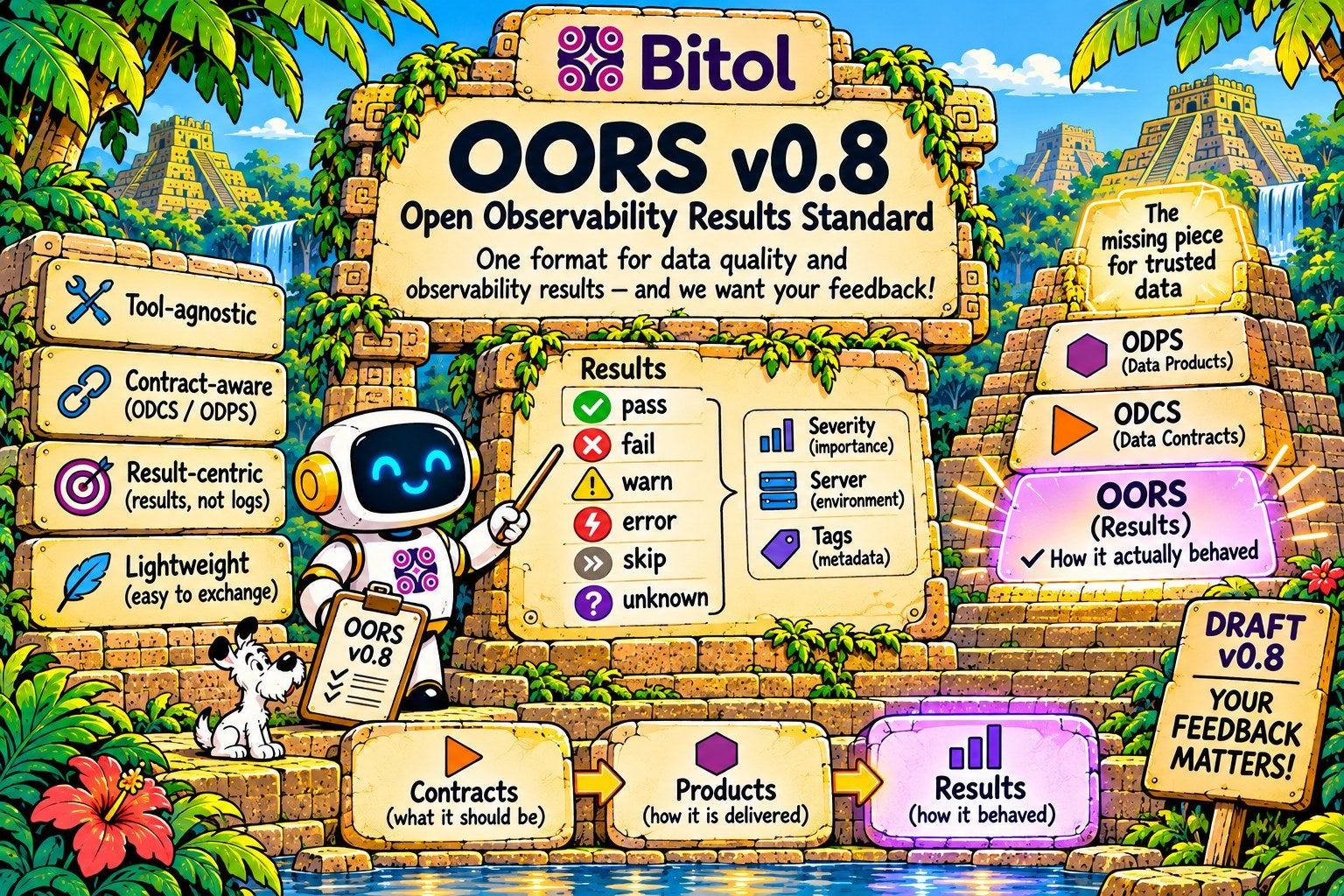
The Open Observability Results Standard (OORS) v0.8 is open for feedback: one lightweight, tool-agnostic format for data quality and observability results, linked to your data contracts.
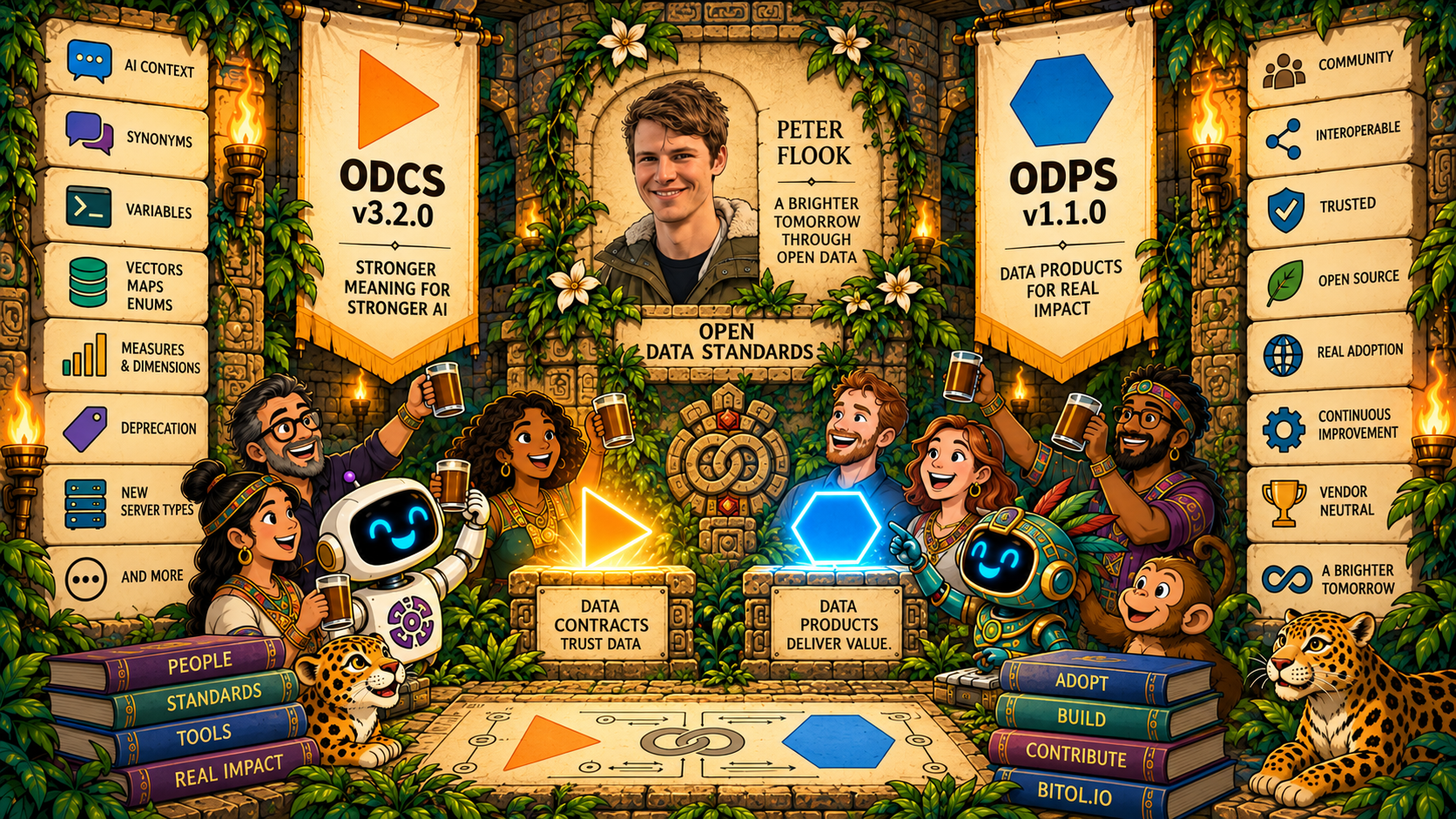
We are thrilled to announce the joint release of Open Data Contract Standard (ODCS) v3.2.0 and Open Data Product Standard (ODPS) v1.1.0. For the first time, both standards ship on…

Yesterday, Bitol officially graduated from the LF AI & Data Foundation. No caps thrown, no processional music. Just a unanimous TAC vote, a Governing Board vote, and about three years…
Bitol Announces ODCS v3.1.0: Stronger, Smarter, and Stricter We are thrilled to announce the release of Open Data Contract Standard (ODCS) version v3.1.0, a significant milestone that brings relationships, stricter…
What Our Community Says
”We currently rely on multiple sources of data, but lack a universal, technology-agnostic standard. An open data contract establishes a common language for everyone to communicate and collaborate effectively.
Peter FlookFounder, Data Catering
Join the Bitol Community
Connect with data engineers, contribute to the standard, and help shape the future of data contracts.
Become a Contributor
Stay up to date on our development progress on GitHub. Join us as an active contributor, or as an end user of the Bitol open standards.
Meet Our Team
Discover our volunteers running the Technical Steering Committee (TSC) that makes Bitol a reality.
Get in Touch
Stay connected with the Bitol project community. All the details are available in our getting started guide.
Join Our Slack
Join our dynamic community on the Slack workspace hosted by the Data Mesh Learning community.
Ready to Standardize Your Data Contracts?
Join hundreds of organizations using Bitol Open Standards to define, govern, and enforce data agreements.