THE LINUX FOUNDATION PROJECTS

Open Data Contract Standard (ODCS)

v3.2.0Apache 2.0Bitol · LF AI & Data

ODCS is an open standard for data contracts: a machine-readable, version-controlled agreement between a data producer and its consumers. It captures what the data is, how it should behave, and the service levels it promises — in YAML that is both human-readable and machine-executable.

View ODCS on GitHubRead the documentation

At a Glance

Open Standard Open Data Contract Standard (ODCS)
Current version v3.2.0 “Peter Flook”
Governance Bitol Technical Steering Committee, under the Linux Foundation AI & Data (graduated project)
Licence Apache 2.0
Media type application/odcs+yaml;version=3.2.0
Repository GitHub
github.com/bitol-io/open-data-contract-standard
Documentation Documentation site
bitol-io.github.io/open-data-contract-standard/
Validation Official JSON Schema published with every release

The current release is named in memory of Peter Flook, a long-time Bitol contributor whose work shaped data quality testing, schema validation and vendor onboarding.

Why ODCS

Agreements live in version control.
A contract is a YAML file, so it is reviewed, diffed and versioned like code rather than buried in a wiki.
Rules are enforceable, not aspirational.
The same document drives validation in CI and at runtime, so quality expectations are checked rather than assumed.
No vendor lock-in.
The standard is vendor-neutral and Apache 2.0, with an ecosystem of compatible tools.
One vocabulary across teams.
Producers publish structure, quality rules and SLAs once; consumers read them instead of asking.
Richer, safer contracts with v3.2.0.
Enumerations, measures and dimensions, vector types and AI context blocks extend what a contract can describe — with no breaking changes.

The Blocks of a Data Contract

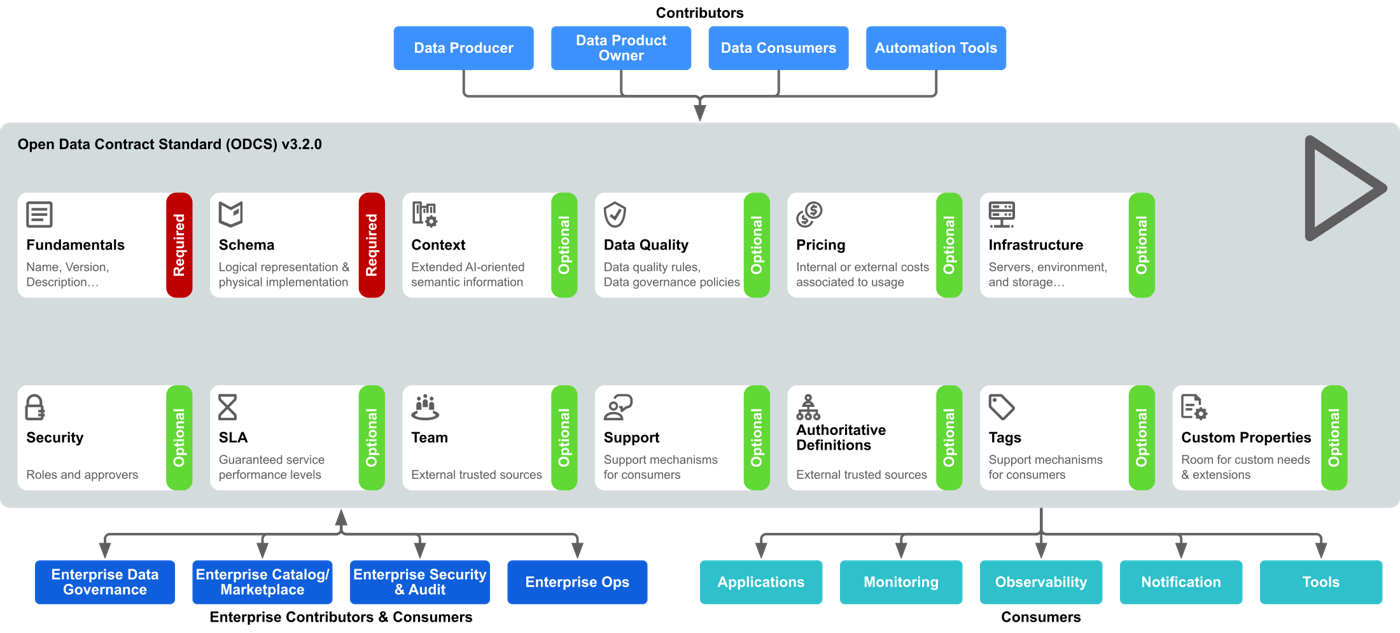
ODCS is assembled from blocks. Two are required — Fundamentals and Schema — and the other eleven are optional, so a contract can start small and grow as the data product it describes matures. Each block has its own page in the documentation, with an example followed by the definition of every field.

The blocks of ODCS v3.2.0. Required blocks are mandatory; optional blocks are adopted as needed.
Block What it holds
Fundamentals Required The standard version and kind (version, apiVersion, kind), the contract's id, name, version, status, domain and tenant.
Schema Required The datasets and their properties — physical and logical types, nullability, primary and foreign keys, nested objects, maps, vectors and enumerations.
Context Optional Instructions, verified statements and constraints that describe the contract to AI agents and semantic tooling.
Data quality Optional Metrics such as rowCount, nullValues and invalidValues, plus native checks for Soda, Great Expectations and dbt — each with a dimension, severity and schedule.
Pricing Optional Internal or external costs associated with using the data.
Infrastructure Optional The servers the data lives on: Snowflake, BigQuery, Databricks, PostgreSQL, Kafka, S3, Apache Iceberg, SAP HANA, Exasol, Teradata and more.
Security Optional Roles and approvals: who may access the data, and in what capacity.
SLA Optional Guaranteed service levels — latency, update frequency, retention, general availability and end-of-life, with values and units.
Team Optional Owners, engineers and subject-matter experts, each with a role and the dates they held it.
Support Optional Support and communication channels for consumers — Slack, Teams, PagerDuty, email.
Authoritative definitions Optional Links to the canonical source of a term or definition — a glossary, ontology or taxonomy.
Tags Optional Free-form labels for search, grouping and governance.
Custom properties Optional Room for vendor-specific or not-yet-standardised needs, each optionally attributed to a vendor.

A Contract, End to End

A complete contract for an orders table: its identity, a context block for AI agents, the Snowflake server it lives on, its schema with an enumeration and a measure, three quality checks built on the standard's own metrics, an SLA and an owner.

version: 1.0.0                            # [A]
apiVersion: v3.2.0                        # [B]
kind: DataContract                        # [C]
id: 53581432-6c55-4ba2-a65f-72344a91553a  # [D]
status: active                            # [E]
name: orders_contract                     # [F]
domain: sales                             # [G]
dataProduct: order-analytics              # [H]

description:                              # [I]
  purpose: Orders placed through the e-commerce storefront.
  limitations: Cancelled orders are excluded.
  usage: Revenue reporting and fulfilment analytics.

context:                                  # [J]
  instructions: >
    Use this contract for revenue reporting. Amounts are in US dollars and
    exclude cancelled orders.
  verifiedStatements:
    - question: What was total revenue last quarter?
      answer: Sum total_amount over order_timestamp for the quarter.
  constraints:
    - constraint: Do not expose customer-level rows outside the sales domain.
      tags: ["pii"]

servers:                                  # [K]
  - server: prod-snowflake
    type: snowflake
    environment: production
    account: acme-prod
    database: SALES
    schema: ORDERS

schema:                                   # [L]
  - name: orders
    physicalType: table
    description: One row per customer order.
    properties:                           # [M]
      - name: order_id
        logicalType: string
        physicalType: VARCHAR(36)
        primaryKey: true                  # [N]
        primaryKeyPosition: 1
        required: true
        description: Surrogate key for the order.
      - name: order_status
        logicalType: string
        description: Fulfilment state of the order.
        enum:                             # [O]
          - value: pending
          - value: shipped
          - value: delivered
      - name: total_amount
        logicalType: number
        physicalType: DECIMAL(12,2)
        semanticType: measure             # [P]
        transformLogic: SUM(total_amount)
        description: Order total, in US dollars.
      - name: order_timestamp
        logicalType: timestamp
        physicalType: TIMESTAMP_NTZ
        required: true
    quality:                              # [Q]
      - metric: rowCount
        mustBeGreaterThan: 0
        type: library
        dimension: completeness
        severity: error
      - metric: nullValues
        mustBe: 0
        type: library
        dimension: completeness
        severity: error
        arguments:
          property: order_id
      - metric: duplicateValues
        mustBe: 0
        type: library
        dimension: uniqueness
        severity: error
        arguments:
          property: order_id

slaProperties:                            # [R]
  - property: frequency
    value: 1
    unit: d
  - property: latency
    value: 3
    unit: h

team:                                     # [S]
  name: Sales Data Platform
  description: Team owning the orders contract.
  members:
    - username: jgperrin
      role: Data Platform Owner
  • [A] The contract's own version. docs
  • [B] The version of the open standard. docs
  • [C] The fixed kind: DataContract. docs
  • [D] A stable, unique identifier. docs
  • [E] Lifecycle status, proposed through retired. docs
  • [F] The contract's name. docs
  • [G] The business domain. docs
  • [H] The data product it belongs to. docs
  • [I] Purpose, limitations and usage. docs
  • [J] Guidance for AI and semantic tools. docs
  • [K] Where the data physically lives. docs
  • [L] The datasets covered. docs
  • [M] The columns and their types. docs
  • [N] The primary key and its position. docs
  • [O] The allowed values for this column. docs
  • [P] A measure, not a grouping column. docs
  • [Q] The rules the data must satisfy. docs
  • [R] Guaranteed service levels. docs
  • [S] Who owns the contract, and in what role. docs

Validation and Tooling

Every release ships an official JSON Schema. Point your editor at it and a contract is validated, autocompleted and linted as you type — and the same schema powers CI checks.

The schema is also published at SchemaStore.org, so editors and IDEs that use the catalogue recognise “*.odcs.yaml” files without manual setup.

VS Code. Map the schema URL to *contract*.yaml in settings.json to get autocompletion and inline errors.

IntelliJ IDEA. Add the same schema URL under Settings › Languages & Frameworks › Schemas and DTDs › JSON Schema Mappings.

CI pipelines. Because a contract is a YAML file, validating it is an ordinary step in a pull request.

Who Uses ODCS

Vendors

Actian

Actian
Databricks

Databricks
Entropy Data

Entropy Data
IBM

IBM

Organisations shipping solutions that natively support the standard, as listed in the standard's own vendors.md (alphabetical).

Users

Boeing

Boeing
GovTech Singapore

GovTech Singapore
Alliander

Alliander
Klarrio

Klarrio
Schwarz Digits

Schwarz Digits

Organisations adopting Bitol's open standards; those shown here have been cleared for public naming.

Adoption is recorded in the Bitol adoption register: jgp.ai/bitoladoption

Consulting

ACA Group

ACA Group
AgileLab

AgileLab
codecentric

codecentric
Thoughtworks

Thoughtworks

Consultancies and trainers helping organisations adopt Bitol's open standards.

Learn More

Join the communityAll Bitol standards