THE LINUX FOUNDATION PROJECTS

Open Observability Results Standard (OORS)

v0.8.1 · draftApache 2.0Bitol · LF AI & Data

OORS is a lightweight, tool-agnostic format for exchanging data quality and data observability results. An OORS message reports the outcomes of checks and metrics — pass or fail, measured values, threshold breaches — optionally linked to the data contract that specified them. It deliberately does not carry raw metrics, traces or logs.
View OORS on GitHubRead the documentation
Draft standard — not ready for production. OORS is published early so the community can see it and shape it. Expect breaking changes in every version until v1.0.0, and incomplete areas. Do not build production systems against it.

At a Glance

Open Standard Open Observability Results Standard (OORS)
Current version v0.8.1 (draft)
Defined by RFC-0018, approved by the Bitol TSC on 2026-10-14
github.com/bitol-io/tsc/blob/main/rfcs/approved/oors-v0.8.0/0018-oors.md
Governance Bitol Technical Steering Committee, under the Linux Foundation AI & Data (graduated project)
Licence Apache 2.0
File extension .oors.yaml (YAML) or JSON
Repository GitHub
github.com/bitol-io/open-observability-results-standard
Documentation Documentation site
bitol-io.github.io/open-observability-results-standard/
Validation Official JSON Schema published with every version

Why OORS

One result format for every tool.
Wrap results from data quality tools, ETL pipelines, OpenTelemetry, vendor platforms or ad-hoc scripts in the same flat message.
Health that points back to the contract.
A result can name the ODCS or ODPS contract, the server and the rule it checked, so a data product exposes its health consistently.
Honest outcomes.
pass, fail, warn, error, skip and unknown are distinct: a check that could not run is never counted as a data failure.
Light enough to send anywhere.
Easy to print, log, send over HTTP or push to a queue; a quality gate reads one overall status field.

The Blocks of an Observability Results Message

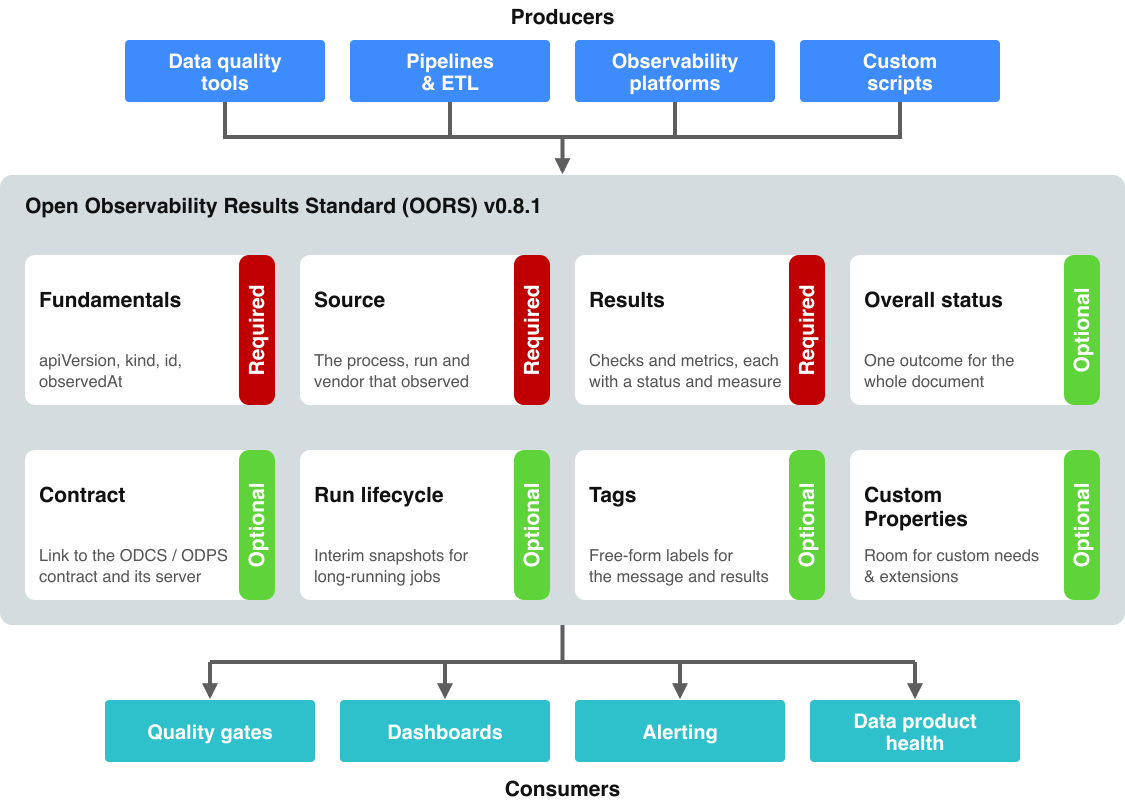
An OORS message has three required blocks — Fundamentals, Source and Results — and five optional ones. A minimal message names its process and reports one result; richer messages add the contract, the run and an overall status.

The blocks of OORS v0.8.1. Required blocks are mandatory; optional blocks are adopted as needed.
Block What it holds
Fundamentals Required The standard version and kind (apiVersion, kind: ObservabilityResults), the message id, and observedAt — when the observations were made.
Source Required The process (job, pipeline) that made the observations, with an optional run id and vendor.
Results Required The observations: each a check or a metric, with a status, severity, data quality dimension, target, measure (metric, value, threshold, unit, row counts) and message. May be empty.
Overall status Optional The outcome of the whole document, derived from the results by a fixed rule so the two never disagree.
Contract Optional The ODCS or ODPS contract the observations are based on — its id, standard, version and server. Highly recommended for traceability.
Run lifecycle Optional Terminal by default, progressive by choice: interim snapshots (running) and a terminal document (completed, aborted) for long-running jobs.
Tags Optional Free-form labels for the message and for each result.
Custom properties Optional Room for vendor-specific or not-yet-standardised needs.

A Results Message, End to End

The results of a nightly run against the orders contract from the ODCS sheet: one failed uniqueness check and one passing freshness metric, linked to the contract and the server they were measured on.

apiVersion: v0.8.1                            # [A]
kind: ObservabilityResults                    # [B]
id: 3d2b6e90-7a1c-4f5b-8e2d-1a9c4b6f0e23      # [C]
observedAt: "2026-01-15T09:30:00Z"            # [D]
status: fail                                  # [E]

source:                                       # [F]
  process: order-processor-dbt
  runId: build-4821
  vendor: soda

run:                                          # [G]
  state: completed
  startedAt: "2026-01-15T09:12:40Z"

contract:                                     # [H]
  contractId: 53581432-6c55-4ba2-a65f-72344a91553a
  standard: ODCS
  version: 1.0.0
  server: prod-snowflake

results:                                      # [I]
  - id: dup_rows_orders
    type: check                               # [J]
    name: No duplicate rows
    status: fail                              # [K]
    severity: critical                        # [L]
    dimension: uniqueness
    relatesTo: schema/orders/quality/no_duplicates  # [M]
    target:
      resourceType: table
      resourceIdentifier: orders
    measure:                                  # [N]
      metric: duplicateValues
      value: 3
      threshold:
        mustBe: 0
      unit: rows
      rowCount: 1200
      failedRowCount: 3
    message: Three duplicate orders found.
  - id: orders_freshness
    type: metric
    name: Orders are fresh
    status: pass
    dimension: timeliness
    target:
      resourceType: table
      resourceIdentifier: orders
    measure:
      metric: age
      value: 42
      threshold:
        mustBeLessThan: 60
      unit: minutes

tags: ["sales"]                               # [O]
  • [A] The version of the open standard. docs
  • [B] The fixed kind: ObservabilityResults. docs
  • [C] A unique identifier for this message. docs
  • [D] When the observations were made. docs
  • [E] The overall outcome of the document. docs
  • [F] The process that observed, its run and vendor. docs
  • [G] The run is finished: this document is terminal. docs
  • [H] The contract and server the results apply to. docs
  • [I] The observations. docs
  • [J] A check (pass/fail) or a metric (measured value). docs
  • [K] The runtime outcome. docs
  • [L] The definition-time importance, orthogonal to status. docs
  • [M] The contract rule this result checks. docs
  • [N] What was measured, against which threshold. docs
  • [O] Free-form labels. docs

Validation and Tooling

Every version ships an official JSON Schema. Files using the .oors.yaml extension are auto-detected as OORS, so an editor can validate and autocomplete a message as you type.

VS Code. Map the schema URL to *.oors.yaml in settings.json to get autocompletion and inline errors.

CI pipelines. Messages are YAML or JSON, so validating them is an ordinary step in a pipeline.

Status

OORS v0.8.0 is the formal consequence of RFC-0018, approved by the TSC on 2026-10-14; v0.8.1 adds an overall status, row counts, filters and an unknown outcome, all non-breaking. There are no published adopters yet. Implementers and reviewers are welcome — the standard is still being shaped.

Learn More

Join the communityAll Bitol standards