THE LINUX FOUNDATION PROJECTS

Open Data Product Standard (ODPS)

v1.1.0Apache 2.0Bitol · LF AI & Data

ODPS is an open standard for data products: a self-contained, reusable asset that delivers tangible business value through data. It defines the structure of a data product — its identity, its input and output ports, the contracts behind those ports, and how it is operated and supported.

View ODPS on GitHubRead the documentation

At a Glance

Open Standard Open Data Product Standard (ODPS)
Current version v1.1.0 “Peter Flook”
Governance Bitol Technical Steering Committee, under the Linux Foundation AI & Data (graduated project)
Licence Apache 2.0
Media type application/odps+yaml;version=1.1.0
Repository GitHub
github.com/bitol-io/open-data-product-standard
Documentation Documentation site
bitol-io.github.io/open-data-product-standard/
Validation Official JSON Schema published with every release

The current release is named in memory of Peter Flook, a long-time Bitol contributor whose work shaped data quality testing, schema validation and vendor onboarding.

Why ODPS

Data becomes a product with an interface.
Input and output ports make a data product's dependencies and promises explicit, so it can be consumed without a conversation.
Contracts and products fit together.
Each output port binds directly to an ODCS data contract, so the interface and the agreement travel as one unit.
Discovery and observability by design.
Management ports standardise how catalogs, quality dashboards and control planes find and operate a product.
Provenance is documented, not assumed.
Lineage, source repositories and SBOM entries record how a product was built.
No vendor lock-in.
The standard is vendor-neutral and Apache 2.0, and reuses the same building blocks as ODCS.

The Blocks of a Data Product

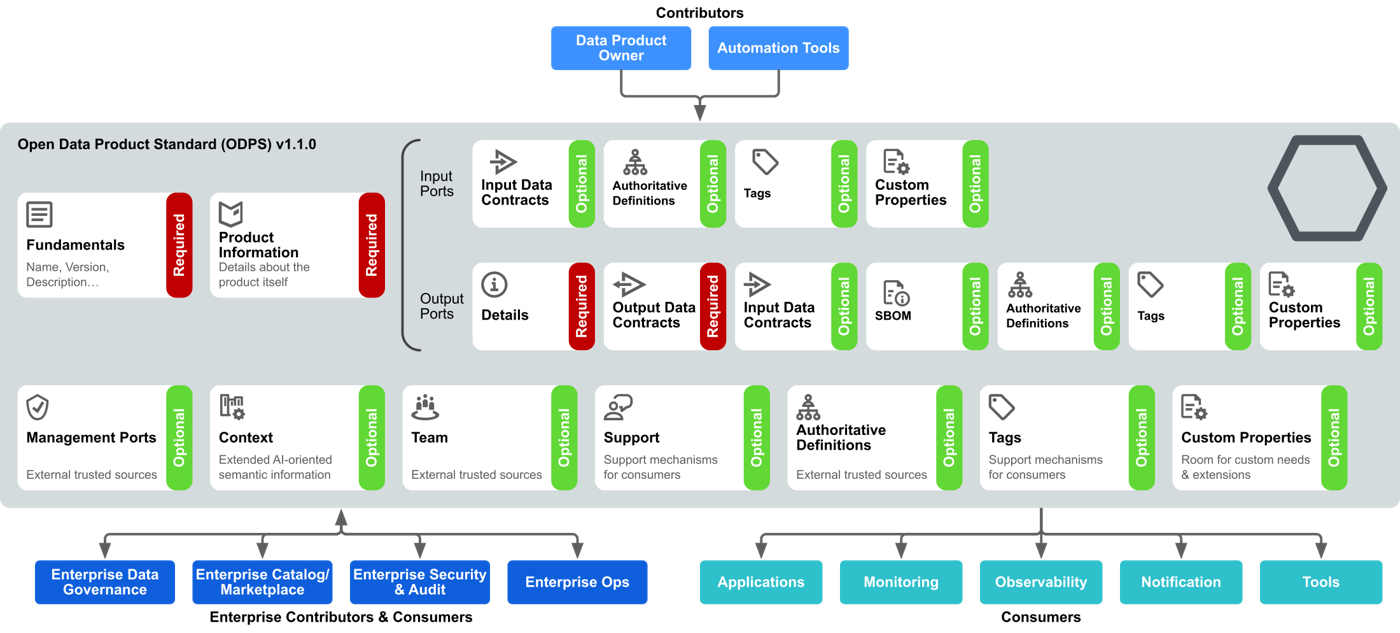
ODPS reuses the block model of ODCS, so the two standards read the same way. Fundamentals and Product Information are required; the rest are optional. Where a block means the same thing in both standards, ODPS links to the ODCS definition rather than restating it.

The blocks of ODPS v1.1.0. Ports are where a data product meets its contracts and its consumers.
Block What it holds
Fundamentals Required The standard version and kind (apiVersion, kind), the product's id, name, version, status, domain, tenant and optional type.
Product information Required The core of the product: its description — purpose, limitations and usage — and the input and output ports that make up its interface.
Input ports Optional The sources the product depends on, each naming the contract it consumes. Only a name is required.
Output ports Optional The assets published to consumers — tables, files, delta tables, event streams or APIs — each bound to an ODCS contract by contractId, with optional SBOM entries recording how it was built.
Management ports Optional How the product is discovered and operated: catalog and search endpoints, observability and quality dashboards, and control-plane administration.
Context Optional Instructions, verified statements and constraints for AI agents and semantic tooling — shared with ODCS v3.2.0.
Team Optional Product owner, data engineers and subject-matter experts, using the same structure as ODCS.
Support Optional Support and communication channels for consumers — Slack, ticketing systems, on-call rotations.
Authoritative definitions Optional Links to the canonical source of a term or definition — shared with ODCS.
Tags Optional Free-form labels for search, grouping and governance.
Custom properties Optional Room for vendor-specific or not-yet-standardised needs, each optionally attributed to a vendor.

A Data Product, End to End

A complete data product: its identity, a context block for AI agents, an input port bound to the orders contract, an output port with its SBOM, a management port, a support channel and an owner.

apiVersion: v1.1.0                            # [A]
kind: DataProduct                             # [B]
id: fbe8d147-28db-4f1d-bedf-a3fe9f458427      # [C]
name: Order Analytics                         # [D]
version: 1.0.0                                # [E]
type: aggregate                               # [F]
status: active                                # [G]
domain: sales                                 # [H]
tenant: AcmeRetail                            # [I]

description:                                  # [J]
  purpose: Curated order metrics for revenue and fulfilment reporting.
  limitations: Excludes cancelled orders.
  usage: Self-service analytics and AI agents.

context:                                      # [K]
  instructions: >
    Prefer the order-metrics port for reporting. Data refreshes daily at 04:00 UTC.
  verifiedStatements:
    - question: What were total orders last month?
      answer: Use the order-metrics output port, summing orders by day.
  constraints:
    - constraint: Do not query more than 90 days without pagination.

inputPorts:                                   # [L]
  - name: source-orders
    version: 1.0.0
    contractId: 53581432-6c55-4ba2-a65f-72344a91553a  # [M]

outputPorts:                                  # [N]
  - name: order-metrics
    description: Aggregated order metrics by day and region.
    type: tables
    version: 1.0.0
    contractId: a44978be-1fe0-4226-b840-1b715bc25c63  # [M]
    sbom:                                     # [O]
      - type: external
        url: https://ci.acme.com/builds/8842/order-metrics.cdx.json

managementPorts:                              # [P]
  - content: dictionary
    type: topic
    name: sales-dict-update
    description: Kafka topic announcing dictionary updates.

support:                                      # [Q]
  - channel: Data Platform Slack
    url: https://acmeretail.slack.com/archives/C1234567890
    tool: slack
    scope: interactive

team:                                         # [R]
  name: Sales Data Platform
  description: Team owning the Order Analytics data product.
  members:
    - username: jgperrin
      role: owner
  • [A] The version of the open standard. docs
  • [B] The fixed kind: DataProduct. docs
  • [C] A stable, unique identifier. docs
  • [D] The product's name. docs
  • [E] The product's own version. docs
  • [F] Architectural alignment. docs
  • [G] Lifecycle status, proposed through retired. docs
  • [H] The business domain. docs
  • [I] The organisational tenant. docs
  • [J] Purpose, limitations and usage. docs
  • [K] Guidance for AI and semantic tools. docs
  • [L] The sources it depends on. docs
  • [M] Binds the port to an ODCS contract. docs
  • [N] The assets published to consumers. docs
  • [O] A bill of materials for the build. docs
  • [P] How the product is discovered. docs
  • [Q] Where consumers go for help. docs
  • [R] Who owns the product. docs

Validation and Tooling

ODPS publishes an official JSON Schema per release. Because a data product is a YAML file, it validates the same way a contract does — in an editor and in CI.

The schema is also published at SchemaStore.org, so editors and IDEs that use the catalogue recognise “*.odps.yaml” files without manual setup.

AJV. Validate a product against the published schema with ajv-cli, using the draft 2019-09 dialect and ajv-formats for the format keywords.

Data Product CLI. Data Product CLI, the open-source sibling of Data Contract CLI, creates, lints and publishes ODPS data products.

Editors. The same schema URL can be mapped in VS Code or IntelliJ, exactly as with ODCS.

Who Uses ODPS

Vendors

Actian

Actian
Databricks

Databricks
Entropy Data

Entropy Data

Organisations shipping solutions that natively support the standard. Open-source tooling — Data Product CLI and FLUID Forge — supports ODPS too.

Users

Boeing

Boeing
GovTech Singapore

GovTech Singapore
Alliander

Alliander
Klarrio

Klarrio
Schwarz Digits

Schwarz Digits

Organisations adopting Bitol's open standards; those shown here have been cleared for public naming.

Adoption is recorded in the Bitol adoption register: jgp.ai/bitoladoption

Consulting

ACA Group

ACA Group
AgileLab

AgileLab
codecentric

codecentric
Thoughtworks

Thoughtworks

Consultancies and trainers helping organisations adopt Bitol's open standards.

Learn More

Join the communityAll Bitol standards