THE LINUX FOUNDATION PROJECTS

Open Maturity Model Standard (OMMS)

v0.2.1 · draftApache 2.0Bitol · LF AI & Data

OMMS defines a common syntax for maturity models — the yardsticks that say how complete, governed and operational an artifact is. It evaluates Bitol artifacts: ODCS data contracts and ODPS data products. A contract or a product describes an asset; a maturity model describes how to evaluate one.
View OMMS on GitHubRead the documentation
Draft standard — not ready for production. OMMS is published early so the community can see it and shape it. Expect breaking changes in every version until v1.0.0, and incomplete areas. Do not build production systems against it.

At a Glance

Open Standard Open Maturity Model Standard (OMMS)
Current version v0.2.1 (draft, 2026-11-16); v0.2.2 in progress
Governance Bitol Technical Steering Committee, under the Linux Foundation AI & Data (graduated project)
Licence Apache 2.0
Media type application/omms+yaml;version=0.2.1
File extension .omms.yaml
Repository GitHub
github.com/bitol-io/open-maturity-model-standard
Documentation In the repository
github.com/bitol-io/open-maturity-model-standard/blob/main/docs/
Validation Official JSON Schema published with every version

Why OMMS

A score you can compute.
Every criterion is factual: a property path, one of two metrics (valueOf, count) and exactly one threshold.
One evaluator for every model.
Maturity models get a formal syntax, so a tool written for one model can evaluate another.
Organisational rules are first-class.
Policies run before any criterion — for example, a deprecated contract cannot score above L2.
Your levels, your names.
The standard fixes how a model is written, never how many levels it has or what they are called.

The Blocks of a Maturity Model

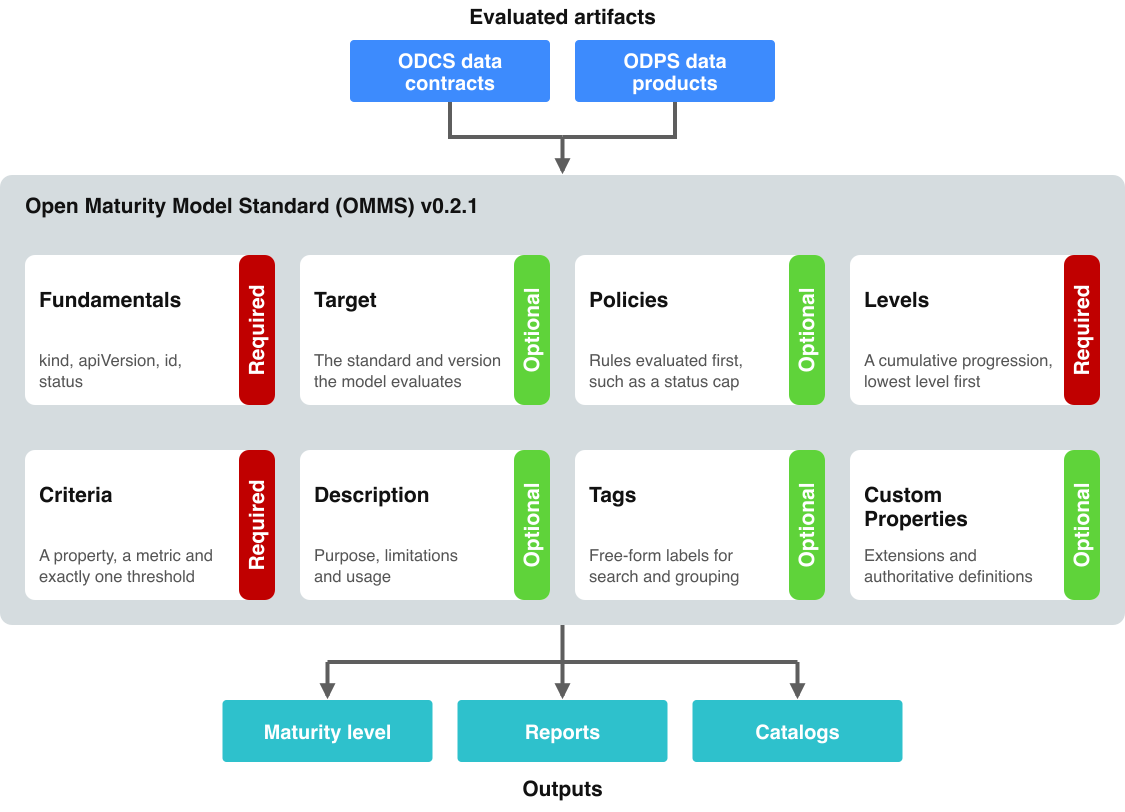
Where ODCS and ODPS are wide — many optional sections side by side — OMMS is deep: one required list of levels, each holding the criteria an artifact must meet, behind an optional list of policies that cap the result.

The blocks of OMMS v0.2.1. Required blocks are mandatory; optional blocks are adopted as needed.
Block What it holds
Fundamentals Required The kind (MaturityModel), apiVersion, id and lifecycle status (proposed, draft, active, deprecated, retired); name and version are strongly recommended.
Levels Required The progression. Levels are cumulative: an artifact reaches a level only when it meets all its criteria and those of every lower level.
Criteria Required Inside each level: an id (L{n}-{X}{nn}), a property path, the valueOf or count metric, optional arguments, exactly one of ten threshold operators, and a unit.
Target Optional targetApplication (ODCS, ODPS…) and targetApiVersion — the standard and version the criteria were written for.
Policies Optional Rules evaluated before any criterion, most often a caps map from status to the maximum achievable level.
Description Optional Purpose, limitations and usage — the same structure as ODCS and ODPS.
Tags Optional Free-form labels for search and grouping.
Custom properties Optional Extensions, plus authoritative definitions linking to the sources behind the model.

A Maturity Model, End to End

A three-level model for the sales domain's data contracts, with a status cap. The level names follow the ODCS maturity model shipped with the standard: Structural, Descriptive, Governed.

kind: MaturityModel                       # [A]
apiVersion: v0.2.1                        # [B]
id: 9f3a2c17-8b4d-4e6a-a1f5-7d9c3e8b2a4f  # [C]
name: sales-contract-maturity
version: 1.0.0                            # [D]
status: active                            # [E]
description:
  purpose: Scores the data contracts of the sales domain.
targetApplication: ODCS                   # [F]
targetApiVersion: v3.2.0

policies:                                 # [G]
  - id: POL-C01
    name: statusCap
    property: status
    type: library
    metric: valueOf
    arguments:
      caps:                               # [H]
        retired: 0
        deprecated: 2
        active: 3
    description: A deprecated contract cannot score above L2.

levels:                                   # [I]
  - level: 1
    name: Structural
    description: The contract is valid.
    criteria:                             # [J]
      - id: L1-C01                        # [K]
        property: kind                    # [L]
        type: library
        metric: valueOf                   # [M]
        mustBe: DataContract              # [N]
        description: The document is a data contract.
  - level: 2
    name: Descriptive
    description: A human can understand it.
    criteria:
      - id: L2-C01
        property: schema[].properties[].description
        type: library
        metric: count                     # [O]
        mustBeGreaterThan: 50
        unit: percent
        description: Most properties are described.
  - level: 3
    name: Governed
    description: Someone is accountable for it.
    criteria:
      - id: L3-C01
        property: team.members
        type: library
        metric: count
        mustBeGreaterOrEqualTo: 1
        unit: rows
        description: The contract names at least one team member.
  • [A] The fixed kind: MaturityModel. docs
  • [B] The version of the open standard. docs
  • [C] A unique identifier for the model. docs
  • [D] The model's own version. docs
  • [E] The model's lifecycle status. docs
  • [F] The standard this model evaluates. docs
  • [G] Rules evaluated before any level. docs
  • [H] Maximum level per status: a ceiling, not a penalty. docs
  • [I] The cumulative progression. docs
  • [J] What an artifact must meet at this level. docs
  • [K] Criterion id: level, target, sequence. docs
  • [L] Where to look in the evaluated document. docs
  • [M] valueOf reads one value. docs
  • [N] Exactly one threshold operator. docs
  • [O] count measures presence and coverage. docs

Validation and Tooling

Every version ships an official JSON Schema, with positive and negative test fixtures the schema must accept and reject. Files using the .omms.yaml extension are auto-detected as OMMS.

VS Code. Map the schema URL to *.omms.yaml in settings.json to get autocompletion and inline errors.

Reference models. The repository ships complete maturity models for ODCS and ODPS (five levels each) to start from.

Status

OMMS first existed as a repository at v0.2.0 (2026-10-16); v0.2.1 (2026-11-16) replaced the criteria metrics with valueOf and count, a breaking change allowed before v1.0.0. There are no published adopters yet, and no documentation site: the documentation lives in the repository. Open questions are tracked as GitHub issues.

Learn More

Join the communityAll Bitol standards