

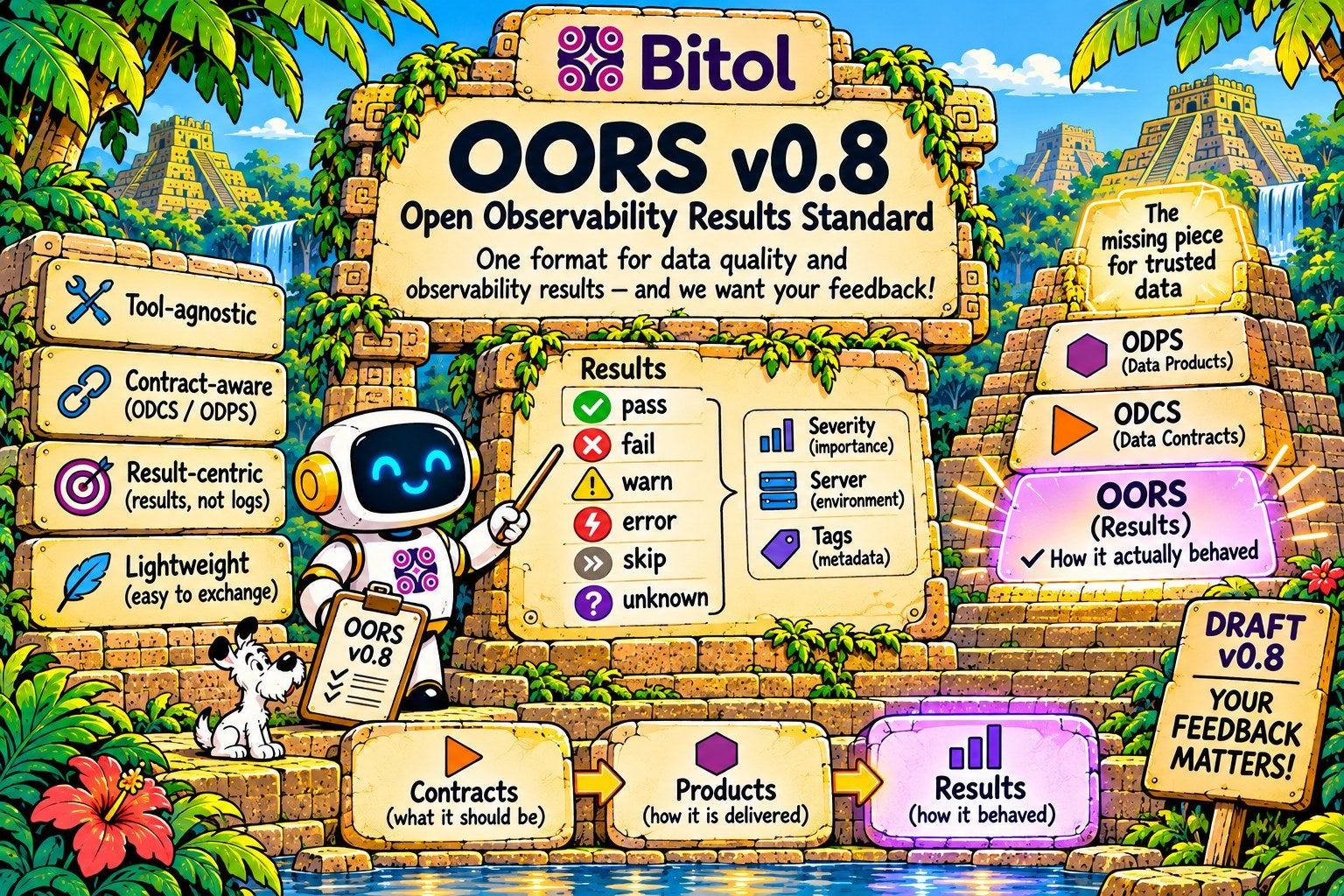
OORS v0.8: One Format for Data Quality and Observability Results — And We Want Your Feedback
The Bitol Technical Steering Committee is opening the Open Observability Results Standard (OORS) v0.8 to the community. OORS is a lightweight, tool-agnostic format for exchanging the results of data quality and data observability checks: pass or fail, measured values and threshold breaches, optionally linked to the data contract that specified them.
OORS is a draft standard. We are publishing it early on purpose: before v1.0.0, every version may still change, and this is the moment when your feedback shapes it most.
We extend our sincere gratitude to the Linux Foundation AI & Data for their continued support and governance. As a graduated LF AI & Data project, Bitol benefits from a neutral, collaborative environment in which vendors and users design open standards together.
Why OORS?
Every data quality tool, pipeline and observability platform reports its results in its own shape. Teams end up writing glue code to collect them, and the link back to the rule that was checked is usually lost on the way. OORS gives all of them one small, flat message:
- Tool-agnostic: wrap results from data quality tools, ETL pipelines, OpenTelemetry, vendor platforms or ad-hoc scripts.
- Contract-aware: a result can name the ODCS or ODPS contract, the server and the rule it checked, so a data product exposes its health consistently.
- Result-centric: OORS carries outcomes, not raw metrics, traces or logs.
- Lightweight: easy to print, log, send over HTTP or push to a queue.
What Is in v0.8
v0.8.0 is the formal consequence of RFC-0018, approved by the TSC on October 14, 2026. It brings:
- Five honest outcomes:
pass,fail,warn,errorandskip. Anerror(the check could not run) is deliberately distinct from afail(the data is bad), so infrastructure problems no longer show up as data failures. - Severity, orthogonal to status: severity is how much a check matters; status is what happened. A critical check that could not run is the loudest possible alert.
- The server a result applies to, as named in the contract, since a contract can be served in several environments.
- Tags, using the same structure as the other Bitol standards.
v0.8.1 adds, without breaking anything:
- An optional overall status for the whole document, so a quality gate or a dashboard reads one field, derived from the results by a fixed rule.
- Row counts (
rowCountandfailedRowCount), so consumers can compute the share of failing rows whatever tool produced the result. - A filter on the target, so a result that covers one partition no longer reads as covering the whole table.
- An
unknownoutcome, for a producer relaying a result it cannot interpret, and support for runs that made no observations. - The start time of a run, so its duration is not lost.
Long-running jobs can also report progressively: interim snapshots while the run is going, then one terminal document that supersedes them.
What It Looks Like
apiVersion: v0.8.1
kind: ObservabilityResults
id: 3d2b6e90-7a1c-4f5b-8e2d-1a9c4b6f0e23
observedAt: "2026-01-15T09:30:00Z"
status: fail
source:
  process: order-processor-dbt
  runId: build-4821
contract:
  contractId: 53581432-6c55-4ba2-a65f-72344a91553a
  standard: ODCS
  version: 1.0.0
  server: prod-snowflake
results:
  - id: dup_rows_orders
    type: check
    name: No duplicate rows
    status: fail
    severity: critical
    dimension: uniqueness
    relatesTo: schema/orders/quality/no_duplicates
    measure:
      metric: duplicateValues
      value: 3
      threshold:
        mustBe: 0
      unit: rows
      rowCount: 1200
      failedRowCount: 3
We Want Your Feedback
The road to v1.0.0 has started: two RFCs, Extensions (RFC-0035) and Variables (RFC-0050), are already approved for OORS v1.0.0. Before we freeze the format, we would love to hear from data engineers, tool vendors and platform teams:
- Can your tool’s results (Soda, Great Expectations, dbt tests, your own checks) be expressed in OORS without losing anything important?
- Do the six outcomes match how you think about results, in particular
errorversusfail, andunknownversusskip? - Is the rule for deriving the overall status the one your quality gates need?
- Does linking a result to a contract, a server and a rule (
relatesTo) give you the traceability you need? - What is missing for you to adopt OORS once it reaches v1.0.0?
Tell us by opening an issue on GitHub, in the OORS Slack channel, or on the RFC discussion.
Thank You
OORS was proposed in RFC-0018 by Patrick Beitsma, Diego Carvallo and Jean-Georges Perrin, and shaped by the Bitol Technical Steering Committee and the contributors listed in the repository. Thank you to everyone who reviewed, challenged and improved it.
Resources
OORS completes the picture that ODCS and ODPS started: contracts say what the data should be, products say how it is delivered, and OORS says how it actually behaved. Help us get it right.
Website: bitol.io
Twitter: @BitolIO
LinkedIn: Bitol Organization
